
IALM ONLINE HOME TUITION
From School Academics to Professional Courses — Get the Best Online Home Tuitions with IALM.
TUTOR ENROLLMENT FORM
Teach. Earn. Grow with IALM.
Join as a faculty and share your expertise with students across subjects. Enjoy flexible schedules, good earning opportunities, and a professional platform.
What You Can Expect:
– Opportunity to teach your area of expertise
– Flexible teaching schedule
– Competitive earning potential
– Access to a wide student base
– Professional association with IALM
Get Started:
Fill the form with your subject expertise and details — we’ll connect with you shortly.
📞 Contact: +91-9650727918 | +91-9266869336
📧 Email: registrar@ialm.academy
STUDENT ENROLLMENT FORM
Learn with the Right Guidance.
Get matched with expert faculty and experience personalized, result-driven learning with live classes and structured support.
What You’ll Get:
– Expert faculty matched to your needs
– Interactive live classes
– Structured study material & tests
– Continuous performance tracking
– Personalized learning experience
Get Started:
Fill the form and begin your learning journey with IALM.
 Contact: +91-9650727918 | +91-9266869336
 Email: registrar@ialm.academy
Fee Structure:
Classes 1–5: Rs 300/- per month per subject
Classes 6–8: Rs 500/- per month per subject
Classes 9–12: Rs 800/- per month per subject
Academic Class / Competitive Exams
Subject Details
CLASS 6th SCIENCE (CBSE) : Food: Where Does It Come From, Components of Food, Fibre to Fabric, Sorting Materials into Groups, Separation of Substances, Changes Around Us, Getting to Know Plants, Body Movements, The Living Organisms & Their Surroundings, Motion and Measurement of Distances, Light, Shadows and Reflections, Electricity and Circuits, Fun with Magnets, Water, Air Around Us, Garbage In, Garbage Out
CLASS 7th SCIENCE (CBSE): Nutrition in Plants, Nutrition in Animals, Fibre to Fabric, Heat, Acids, Bases and Salts, Physical & Chemical Changes, Weather, Climate and Adaptations, Winds, Storms and Cyclones, Soil, Respiration in Organisms, Transportation in Animals & Plants, Reproduction in Plants, Motion and Time, Electric Current & Its Effects, Light, Water: A Precious Resource, Forests: Our Lifeline, Wastewater Story
CLASS 8th SCIENCE (CBSE): Crop Production & Management, Microorganisms: Friend and Foe, Synthetic Fibres & Plastics, Materials: Metals and Non-Metals, Coal and Petroleum, Combustion and Flame, Conservation of Plants & Animals, Cell – Structure & Functions, Reproduction in Animals, Reaching the Age of Adolescence, Force & Pressure, Friction, Sound, Chemical Effects of Electric Current, Some Natural Phenomena, Light, Stars and the Solar System, Pollution of Air and Water
CLASS 9th SCIENCE (CBSE): Physics: Motion, Force and Laws of Motion, Gravitation, Work and Energy, and Sound.
Chemistry: Matter in Our Surroundings, Is Matter Around Us Pure, Atoms and Molecules, and Structure of the Atom.
Biology: The Fundamental Unit of Life, Tissues, Diversity in Living Organisms, Why Do We Fall Ill, Natural Resources, and Improvement in Food Resources.
CLASS 10th SCIENCE (CBSE): Physics: Light – Reflection and Refraction, Human Eye and Colourful World, Electricity, and Magnetic Effects of Electric Current.
Chemistry: Chemical Reactions and Equations, Acids, Bases and Salts, Metals and Non-metals, Carbon and Its Compounds, and Periodic Classification of Elements.
Biology: Life Processes, Control and Coordination, How Do Organisms Reproduce, Heredity and Evolution, Our Environment, and Management of Natural Resources.
CLASS 6th SOCIAL STUDIES (CBSE): History: What, Where, How and When; From Hunting–Gathering to Growing Food; In the Earliest Cities; What Books and Burials Tell Us; Kingdoms, Kings and an Early Republic; New Questions and Ideas; Ashoka, the Emperor Who Gave Up War; Vital Villages, Thriving Towns; Traders, Kings and Pilgrims; New Empires and Kingdoms; Buildings, Paintings and Books.
Geography: The Earth in the Solar System; Globe: Latitudes and Longitudes; Motions of the Earth; Maps; Major Domains of the Earth; Major Landforms of the Earth; Our Country – India; India: Climate, Vegetation and Wildlife.
Civics: Understanding Diversity; Diversity and Discrimination; What is Government; Key Elements of a Democratic Government; Panchayati Raj; Rural Administration; Urban Administration; Rural Livelihoods; Urban Livelihoods.
Class 7th SOCIAL STUDIES (CBSE): History: Tracing Changes Through a Thousand Years; New Kings and Kingdoms; The Delhi Sultans; The Mughal Empire; Rulers and Buildings; Towns, Traders and Craftspersons; Tribes, Nomads and Settled Communities; Devotional Paths to the Divine; The Making of Regional Cultures; Eighteenth-Century Political Formations.
Geography: Environment; Inside Our Earth; Our Changing Earth; Air; Water; Natural Vegetation and Wildlife; Human Environment – Settlement, Transport and Communication; Human Environment Interactions.
Civics: On Equality; Role of Government in Health; How the State Government Works; Growing Up as Boys and Girls; Women Change the World; Understanding Media; Markets Around Us; A Shirt in the Market; Struggles for Equality.
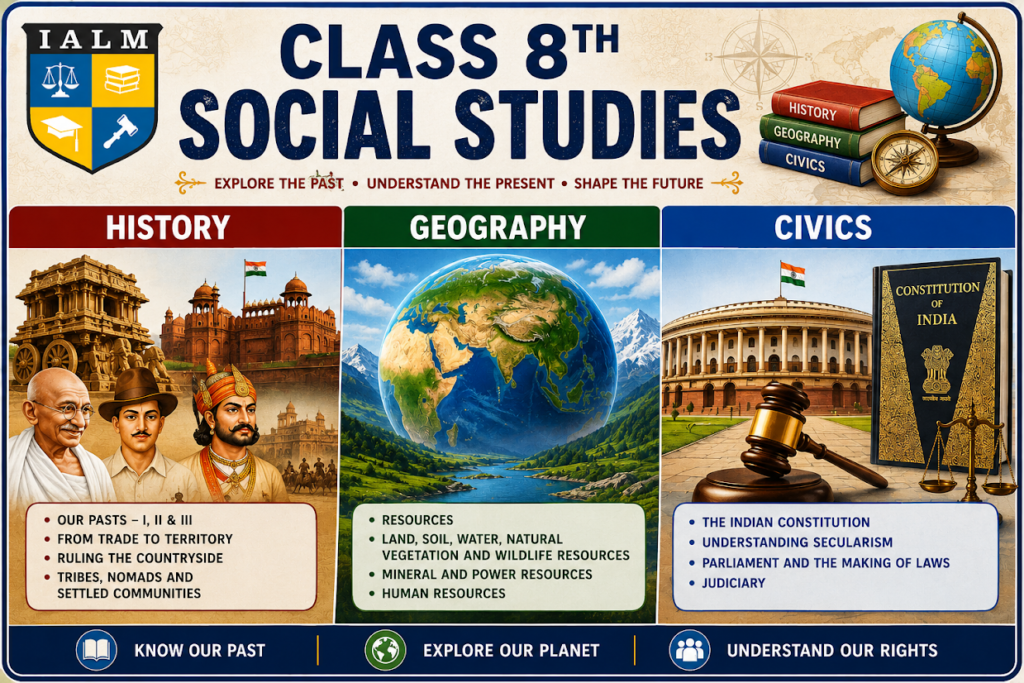
Class 8th SOCIAL STUDIES (CBSE): History: How, When and Where; From Trade to Territory; Ruling the Countryside; Tribals, Dikus and the Vision of a Golden Age; When People Rebel (1857 Revolt); Colonialism and the City; Weavers, Iron Smelters and Factory Owners; Civilising the “Native”, Educating the Nation; Women, Caste and Reform; The Changing World of Visual Arts; The Making of the National Movement; India After Independence.
Geography: Resources; Land, Soil, Water, Natural Vegetation & Wildlife Resources; Mineral and Power Resources; Agriculture; Industries; Human Resources.
Civics: The Indian Constitution; Understanding Secularism; Why Do We Need a Parliament; Understanding Laws; Judiciary; Understanding Our Criminal Justice System; Understanding Marginalisation; Confronting Marginalisation; Public Facilities; Law and Social Justice.
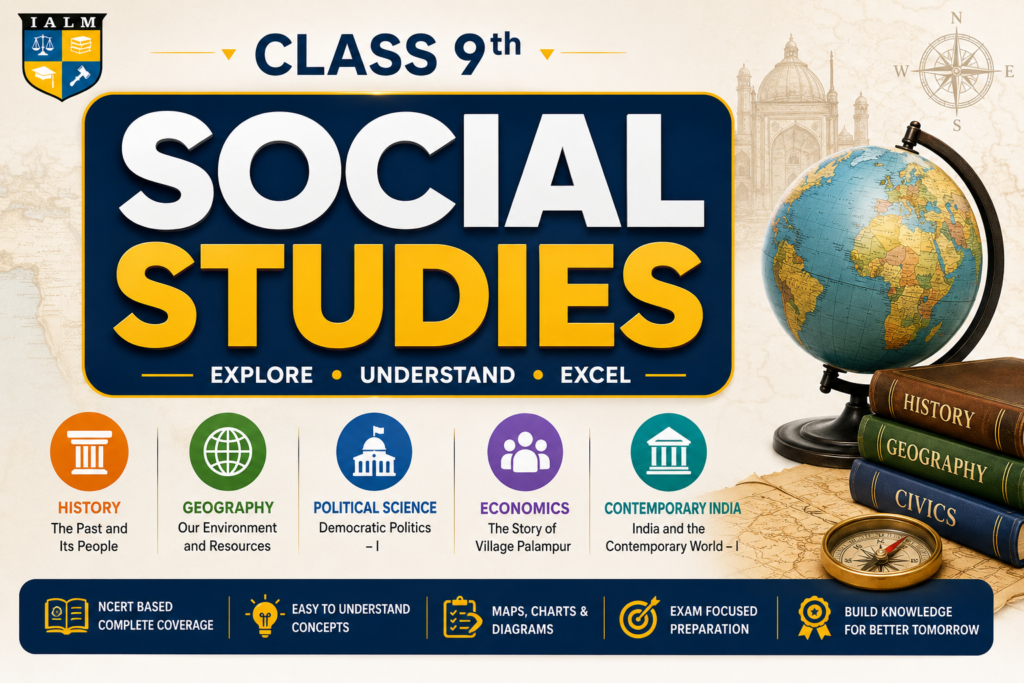
Class 9th SOCIAL STUDIES (CBSE): History – The French Revolution, Socialism in Europe and the Russian Revolution, Nazism and the Rise of Hitler, Forest Society and Colonialism, Pastoralists in the Modern World
Geography – India – Size and Location, Physical Features of India, Drainage, Climate, Natural Vegetation and Wildlife, Population
Civics – What is Democracy? Why Democracy?, Constitutional Design, Electoral Politics, Working of Institutions, Democratic Rights
Economics – The Story of Village Palampur, People as Resource, Poverty as a Challenge, Food Security in India
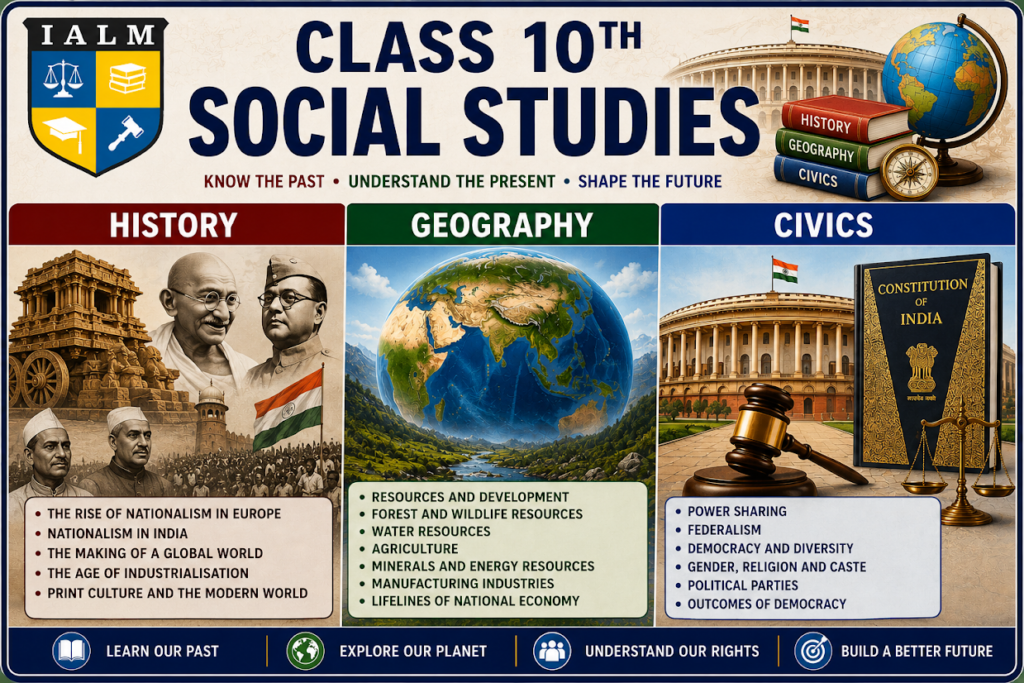
Class 10th SOCIAL STUDIES (CBSE): History – The Rise of Nationalism in Europe, Nationalism in India, The Making of a Global World, The Age of Industrialisation, Print Culture and the Modern World
Geography – Resources and Development, Forest and Wildlife Resources, Water Resources, Agriculture, Minerals and Energy Resources, Manufacturing Industries, Lifelines of the National Economy
Civics – Power Sharing, Federalism, Gender, Religion and Caste, Political Parties, Outcomes of Democracy
Economics – Development, Sectors of the Indian Economy, Money and Credit, Globalisation and the Indian Economy, Consumer Rights
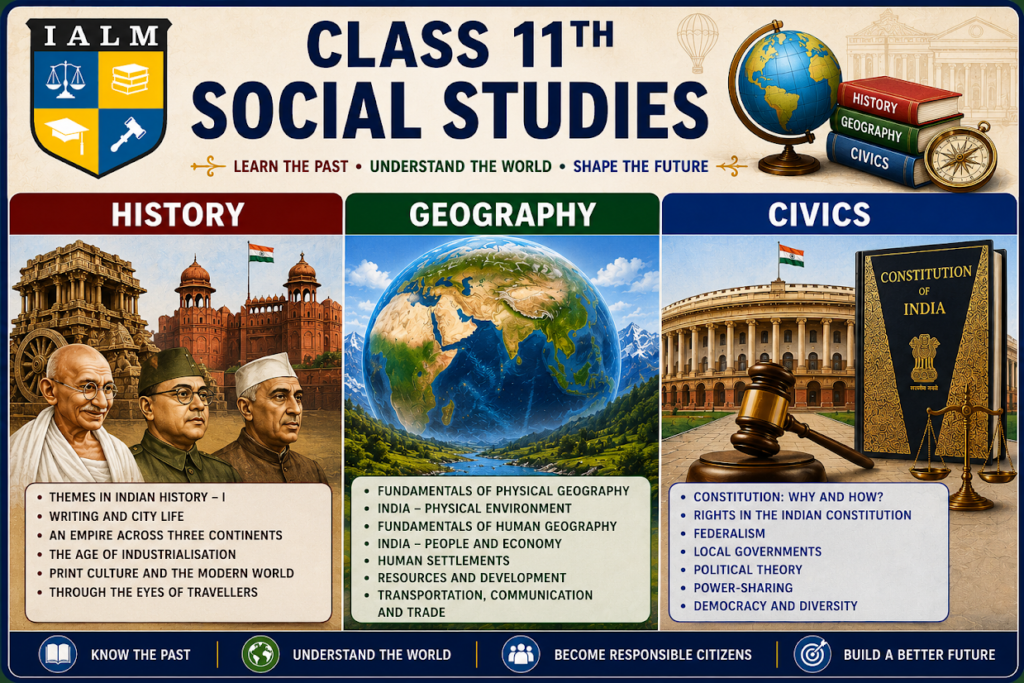
Class 11th SOCIAL STUDIES (CBSE): History – Writing and City Life, An Empire Across Three Continents, Nomadic Empires, The Three Orders, Changing Cultural Traditions, Displacing Indigenous Peoples, Paths to Modernisation
Geography – Geography as a Discipline, The Origin and Evolution of the Earth, Interior of the Earth, Distribution of Oceans and Continents, Minerals and Rocks, Geomorphic Processes, Landforms, Composition and Structure of Atmosphere, Solar Radiation, Atmospheric Circulation, Water in the Atmosphere, World Climate, Water (Oceans), Ocean Movements, Life on Earth
Political Science – Constitution, Rights, Election, Executive, Legislature, Judiciary, Federalism, Local Governments, Constitution as a Living Document, Political Theory, Freedom, Equality, Social Justice, Rights, Citizenship, Nationalism, Secularism
Economics – Indian Economy on the Eve of Independence, Indian Economy (1950–1990), Liberalisation, Privatisation and Globalisation, Poverty, Human Capital Formation, Rural Development, Employment, Infrastructure, Environment, Statistics for Economics – Collection, Organisation, Presentation of Data, Measures (Mean, Median, Mode), Correlation
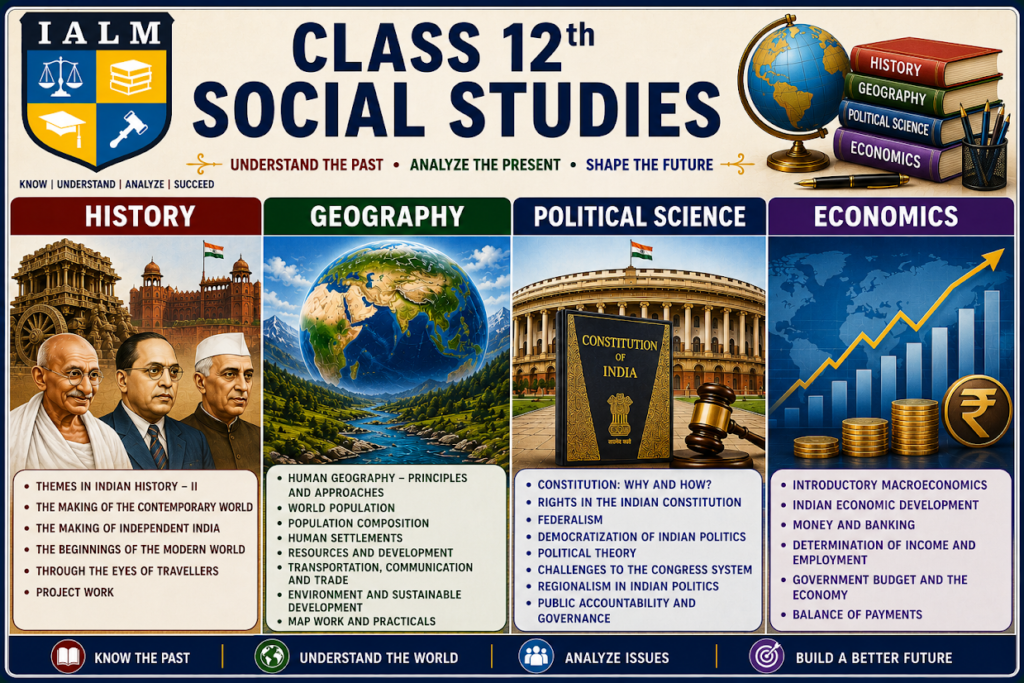
Class 12th SOCIAL STUDIES (CBSE): History– Harappan Civilisation, Kings, Farmers and Towns, Kinship, Caste and Class, Thinkers, Beliefs and Buildings, Through the Eyes of Travellers, Bhakti-Sufi Traditions, Vijayanagara Empire, Mughal Court, Colonialism and Countryside, Rebels and the Raj, Mahatma Gandhi and National Movement, Framing of the Constitution
Geography – Human Geography, Population, Human Activities, Transport and Communication, International Trade, Population, Human Settlements, Resources, Agriculture, Industries, Planning, Transport
Political Science – Cold War Era, End of Bipolarity, US Dominance, Alternative Centres of Power, Contemporary South Asia, International Organisations, Security, Environment, Globalisation, Politics – Nation-Building, Planning and Development, Politics of 1960s, Emergency, Regional Aspirations, Rise of New Movements, Recent Developments
Economics – National Income, Money and Banking, Determination of Income, Government Budget, Balance of Payments, Development Experience, Economic Reforms, Current Challenges
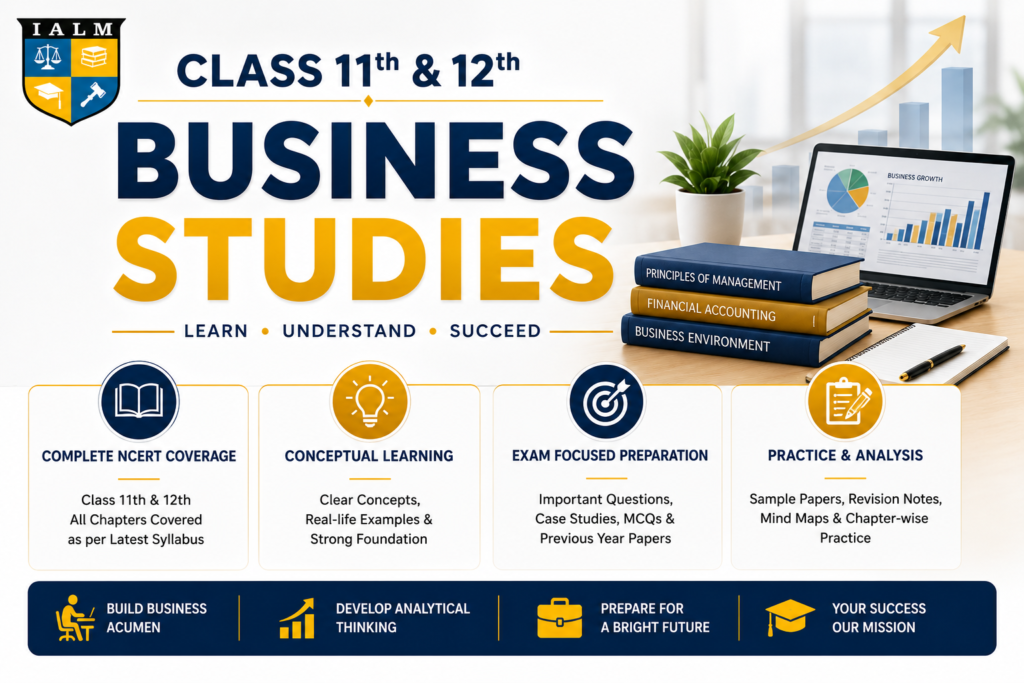
Class 11th and 12th BUSINESS STUDIES (CBSE): Nature and Purpose of Business, Forms of Business Organisation, Private, Public and Global Enterprises, Business Services, Emerging Modes of Business, Social Responsibilities of Business and Business Ethics, Sources of Business Finance, Small Business and Entrepreneurship, Internal Trade, International Business, Nature and Significance of Management, Principles of Management, Business Environment, Planning, Organising, Staffing, Directing, Controlling, Financial Management, Financial Markets, Marketing Management, Consumer Protection
Up to Class 9th MATHEMATICS/MATHS (CBSE): Knowing Our Numbers, Whole Numbers, Playing with Numbers, Basic Geometrical Ideas, Understanding Elementary Shapes, Integers, Fractions, Decimals, Data Handling, Mensuration, Algebra, Ratio and Proportion, Symmetry, Practical Geometry, Integers, Fractions and Decimals, Data Handling, Simple Equations, Lines and Angles, The Triangle and its Properties, Congruence of Triangles, Comparing Quantities, Rational Numbers, Practical Geometry, Perimeter and Area, Algebraic Expressions, Exponents and Powers, Symmetry, Visualising Solid Shapes, Rational Numbers, Linear Equations in One Variable, Understanding Quadrilaterals, Practical Geometry, Data Handling, Squares and Square Roots, Cubes and Cube Roots, Comparing Quantities, Algebraic Expressions and Identities, Visualising Solid Shapes, Mensuration, Exponents and Powers, Direct and Inverse Proportions, Factorisation, Introduction to Graphs, Number Systems, Polynomials, Coordinate Geometry, Linear Equations in Two Variables, Introduction to Euclid’s Geometry, Lines and Angles, Triangles, Quadrilaterals, Areas of Parallelograms and Triangles, Circles, Constructions, Heron’s Formula, Surface Areas and Volumes, Statistics, Probability
Class 10th, 11th and 12th MATHEMATICS/MATHS (CBSE): Real Numbers, Polynomials, Pair of Linear Equations in Two Variables, Quadratic Equations, Arithmetic Progressions, Triangles, Coordinate Geometry, Trigonometry, Some Applications of Trigonometry, Circles, Constructions, Areas Related to, Circles, Surface Areas and Volumes, Statistics, Sets, Relations and Functions, Trigonometric Functions, Principle of Mathematical Induction, Complex Numbers and Quadratic Equations, Linear Inequalities, Permutations and Combinations, Binomial Theorem, Sequences and Series, Straight Lines, Conic Sections, Introduction to Three-Dimensional Geometry, Limits and Derivatives, Mathematical Reasoning, Statistics, Probability, Relations and Functions, Inverse Trigonometric Functions, Matrices, Determinants, Continuity and Differentiability, Applications of Derivatives, Integrals, Applications of Integrals, Differential Equations, Vector Algebra, Three-Dimensional Geometry, Linear Programming,
Up to Class 9th ENGLISH (CBSE): Literature (Honeysuckle & Supplementary), Honeysuckle Chapters (1–10), Poems (8), A Pact with the Sun Chapters (1–10), Grammar, Noun, Pronoun, Verb (Tense – Present, Past, Future), Adjective, Adverb, Articles (A, An, The), Prepositions, Conjunctions, Sentence Formation, Punctuation, Paragraph Writing, Message Writing
Literature (Honeycomb & Supplementary), Honeycomb Chapters (1–10), Poems (8), An Alien Hand Chapters (1–10), Parts of Speech (revision), Tenses, Modals (can, could, may, might, must)
Active & Passive Voice (basic), Direct & Indirect Speech (basic), Adjectives & Adverbs, Prepositions, Conjunctions, Notice Writing, English Literature (Honeydew & Supplementary), Honeydew Chapters (1–8), Poems (8), It So Happened Chapters (1–8), Tenses (advanced), Modals, Active & Passive Voice, Direct & Indirect Speech, Determiners, Prepositions, Conjunctions, Notice Writing, Diary Entry, Literature (Beehive & Moments), Beehive Chapters (1–11), Poems (7), Moments Chapters (1–10), Tenses, Modals, Determiners, Subject-Verb Agreement, Active & Passive Voice, Direct & Indirect Speech, Prepositions, Writing Skills, Descriptive Paragraph, Story Writing, Diary Entry, Formal Letter Writing, Informal Letter Writing, Article Writing, Debate / Speech Writing, Who Did Patrick’s Homework?, A House, A Home, The Kite, How the Dog Found Himself a New Master!, A Tale of Two Birds, The Friendly Mongoose, Three Questions, A Gift of Chappals, Gopal and the Hilsa Fish,The Squirrel, The Rebel, The Shed, The Best Christmas Present in the World, The Tsunami, Glimpses of the Past, The Fun They Had, The Sound of Music, The Little Girl, A Truly Beautiful Mind, The Snake and the Mirror, My Childhood, Packing
Class 10th, 11th and 12th ENGLISH (CBSE): First Flight (Main Reader), A Letter to God, Nelson Mandela: Long Walk to Freedom, Two Stories about Flying, From the Diary of Anne Frank, The Hundred Dresses – I, The Hundred Dresses – II, Glimpses of India, Mijbil the Otter, Madam Rides the Bus, The Sermon at Benares, The Proposal, Poems, Dust of Snow, Fire and Ice, A Tiger in the Zoo, How to Tell Wild Animals, The Ball Poem, Amanda!, The Trees, Fog, The Tale of Custard the Dragon, For Anne Gregory, Footprints Without Feet (Supplementary Reader), A Triumph of Surgery, The Thief’s Story, The Midnight Visitor, A Question of Trust, Footprints Without Feet, The Making of a Scientist, The Necklace, The Hack Driver, Bholi, The Book That Saved the Earth, Hornbill (Main Reader), The Portrait of a Lady, We’re Not Afraid to Die… If We Can All Be Together, Discovering Tut: The Saga Continues, Landscape of the Soul, The Ailing Planet: The Green Movement’s Role, The Browning Version, The Adventure, Silk Road, Poems, A Photograph, The Laburnum Top, The Voice of the Rain, Childhood, Father to Son, Snapshots (Supplementary Reader), The Summer of the Beautiful White Horse, The Address, Ranga’s Marriage, Albert Einstein at School, Mother’s Day, The Ghat of the Only World, Birth, The Tale of Melon City, Flamingo (Main Reader), The Last Lesson, Lost Spring, Deep Water, The Rattrap, Indigo, Poets and Pancakes, The Interview, Going Places, Poems, My Mother at Sixty-Six, An Elementary School Classroom in a Slum, Keeping Quiet, A Thing of Beauty, A Roadside Stand, Aunt Jennifer’s Tigers, Vistas (Supplementary Reader), The Third Level, The Tiger King, Journey to the End of the Earth, The Enemy, Should Wizard Hit Mommy?, On the Face of It, Evans Tries an O-Level, Memories of Childhood, Tenses, Modals, Subject-Verb Agreement, Determiners, Clauses, Voice, Reported Speech, Active & Passive Voice, Direct & Indirect Speech, Letter Writing (Formal – Complaint, Enquiry, Order, Editor), Analytical Paragraph Writing, Report Writing, Notice Writing, Poster Making, Speech Writing, Debate Writing, Article Writing, Analytical Paragraph Writing (Based on Charts, Graphs, Tables, Data Interpretation)
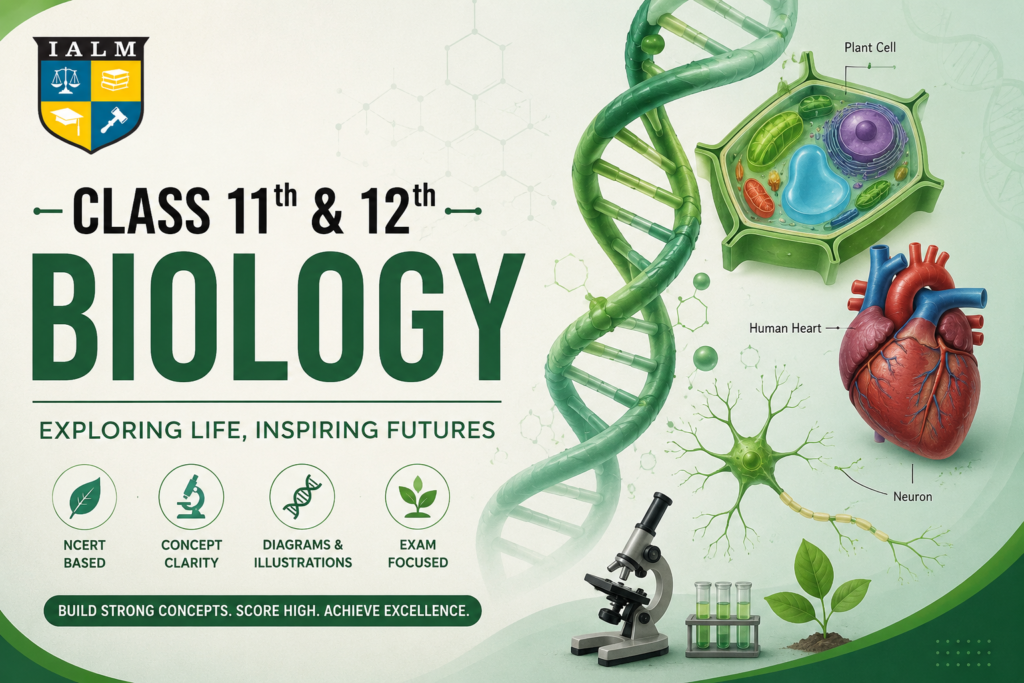
Class 11th and 12th BIOLOGY (CBSE): The Living World, Biological Classification, Plant Kingdom, Animal Kingdom, Morphology of Flowering Plants, Anatomy of Flowering Plants, Structural Organisation in Animals, Cell: Structure & Function, Biomolecules, Cell,, Cycle & Division, Transport in Plants, Mineral Nutrition, Photosynthesis, Respiration in Plants, Plant Growth & Development, Digestion & Absorption, Breathing & Exchange of Gases, Body Fluids & Circulation, Excretory Products, Locomotion & Movement, Neural Control & Coordination, Chemical Coordination, Reproduction in Organisms, Sexual Reproduction in Flowering Plants, Human Reproduction, Reproductive Health, Principles of Inheritance, Molecular Basis of Inheritance, Evolution, Human Health & Disease, Microbes in Human Welfare, Biotechnology Principles, Biotechnology Applications, Organisms & Populations, Ecosystem, Biodiversity & Conservation, Environmental Issues
Class 11th and 12th PHYSICS (CBSE): Physical World, Units and Measurements, Motion in a Straight Line, Motion in a Plane, Laws of Motion, Work, Energy and Power, System of Particles and Rotational Motion, Gravitation, Mechanical Properties of Solids, Mechanical Properties of Fluids, Thermal Properties of Matter, Thermodynamics, Kinetic Theory, Oscillations, Waves, Electric Charges and Fields, Electrostatic Potential and Capacitance, Current Electricity, Moving Charges and Magnetism, Magnetism and Matter, Electromagnetic Induction, Alternating Current, Electromagnetic Waves, Ray Optics and Optical Instruments, Wave Optics, Dual Nature of Radiation and Matter, Atoms, Nuclei, Semiconductor Electronics, Communication Systems
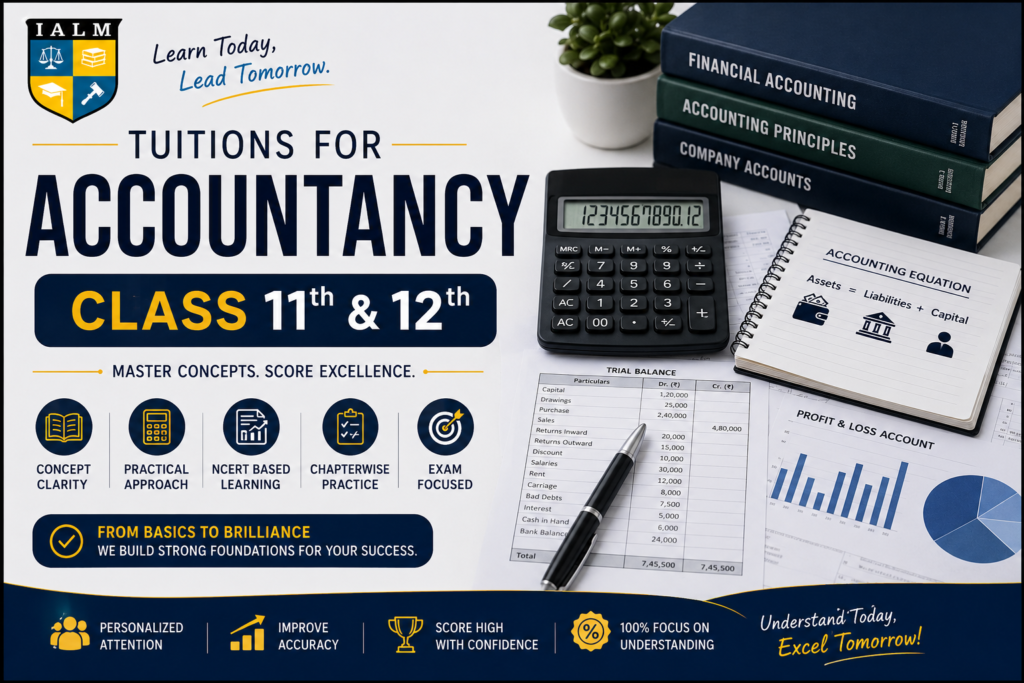
Class 11th and 12th ACCOUNTANCY/ACCOUNTS(CBSE): Part A – Financial Accounting I – Introduction to Accounting, Theory Base of Accounting, Recording of Transactions – I, Recording of Transactions – II, Bank Reconciliation Statement, Trial Balance and Rectification of Errors
Part B – Financial Accounting II – Depreciation, Provisions and Reserves, Bills of Exchange, Financial Statements – I, Financial Statements – II, Accounts from Incomplete Records
Part A – Accounting for Partnership Firms and Companies – Accounting for Partnership Firms – Fundamentals, Change in Profit Sharing Ratio Among the Existing Partners, Admission of a Partner, Retirement or Death of a Partner, Dissolution of a Partnership Firm, Accounting for Share Capital, Issue of Debentures
Part B – Financial Statement Analysis – Financial Statements of a Company, Financial Statement Analysis, Accounting Ratios, Cash Flow Statement
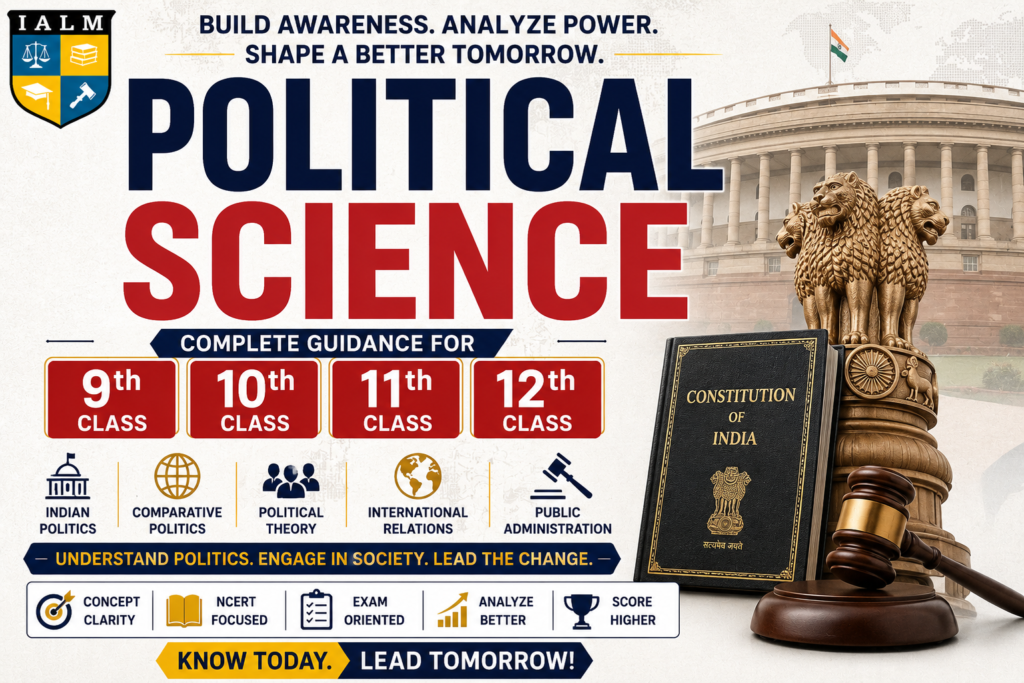
Class 9th, 10th, 11th and 12th POLITICAL SCIENCE (CBSE): What is Democracy? Why Democracy?, Constitutional Design, Electoral Politics, Working of Institutions, Democratic Rights, Power Sharing, Federalism, Gender, Religion and Caste, Political Parties, Outcomes of Democracy, Indian Constitution at Work, Constitution: Why and How?, Rights in the Indian Constitution, Election and Representation, Executive, Legislature, Judiciary, Federalism, Local Governments, Constitution as a Living Document, Political Theory, Political Theory: An Introduction, Freedom, Equality, Social Justice, Rights, Citizenship, Nationalism, Secularism, Contemporary World Politics, The Cold War Era, The End of Bipolarity, US Hegemony in World Politics, Alternative Centres of Power, Contemporary South Asia, International Organisations, Security in the Contemporary World, Environment and Natural Resources, Globalisation, Politics in India Since Independence, Challenges of Nation Building, Era of One-Party Dominance, Politics of Planned Development, India’s External Relations, Challenges to and Restoration of Congress System, The Crisis of Democratic Order, Regional Aspirations, Recent Developments in Indian Politics
Class 11th and 12th SOCIOLOGY (CBSE): Introducing Sociology, Sociology and Society, Understanding Social Institutions, Culture and Socialisation, Doing Sociology: Research Methods, Social Change and Social Order in Rural and Urban Society, Indian Society: Past and Present, Social Institutions: Continuity and Change, Social Inequality and Exclusion, The Challenges of Cultural Diversity, Suggestions for Project Work, Structure of Indian Society, Social Institutions: Continuity and Change (India), Patterns of Social Inequality and Exclusion, The Challenges of Cultural Diversity (India), Social Change and Development in India, Change and Development in Rural Society, Change and Development in Industrial Society, Globalisation and Social Change, Mass Media and Communications, Social Movements
Class 11th and 12th ENTREPRENEURSHIP (CBSE):): Entrepreneurship: Concept and Functions, Entrepreneurial Journey, Entrepreneurship as Innovation and Problem Solving, Market Research, Business Planning, Forms of Business Organisation, Resource Mobilisation, Marketing Management, Financial Management, Human Resource Management, Growth Strategies, Business Environment, Enterprise Growth and Expansion, Intellectual Property Rights, Social Entrepreneurship
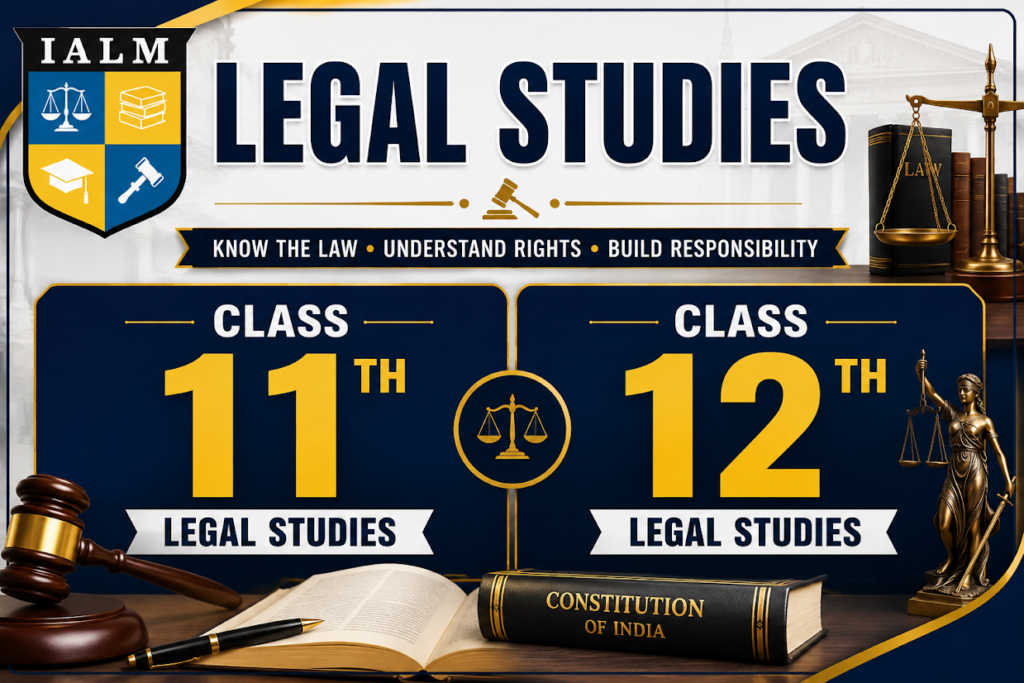
Class 11th and 12th LEGAL STUDIES (CBSE): Introduction to Law, Sources of Law, Classification of Laws, Functions of Law, Rule of Law, Legal Maxims, Judiciary: Structure and Hierarchy, Independence of Judiciary, Access to Justice, Legal Services and Legal Aid, Dispute Resolution Mechanisms (ADR), Arbitration, Mediation, Conciliation, Lok Adalats, Indian Constitution: Features and Principles, Fundamental Rights, Fundamental Duties, Directive Principles of State Policy, Law of Contracts, Essentials of a Valid Contract, Breach of Contract and Remedies, Law of Torts, Negligence, Liability and Remedies,Criminal Law (IPC/BNS), Types of Offences, Criminal Liability, Defences in Criminal Law, Family Law (Hindu and Muslim), Marriage, Divorce, Maintenance, Adoption, Property Law Basics, Ownership and Transfer of Property, Intellectual Property Rights, Copyright, Trademark, Patent, Cyber Law, Cyber Crimes and Digital Security, Consumer Protection Law, Consumer Rights and Remedies, Environmental Law, Sustainable Development, Human Rights, National and International Framework, Legal Profession in India, Roles of Lawyers and Judges, Legal Research and Writing, Case Analysis, Moot Court Exercises
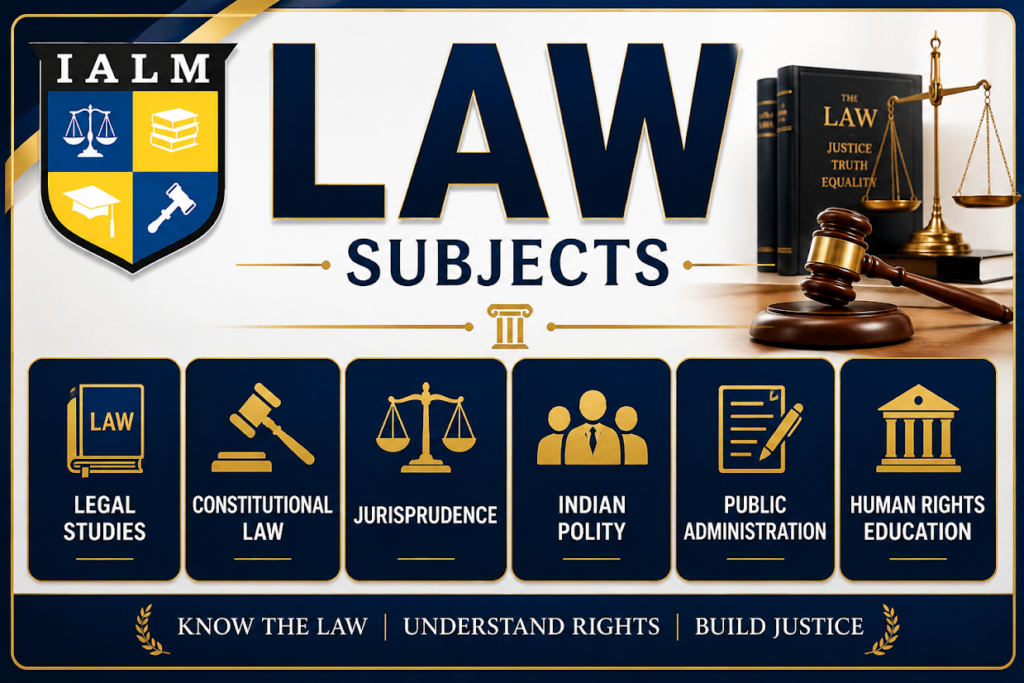
LAW SUBJECTS: BSA 2023, Corporate Law, BNSS 2023, Limitation Act, Probation of Offenders Law, Contract Act, Partnership Act, Civil Procedure Code (CPC), Companies Act, Banking Laws, Negotiable Instruments Act, Constitution of India, Law of Torts, Jurisprudence, Administrative Law, Criminal Law (IPC/CrPC), Intellectual Property Law, Competition Act 2002, POSH Act, Domestic Violence Law, POCSO Act, Indecent Representation of Women Act, Family Law (Hindu), Family Law (Muslim), Specific Relief Act, Cyber Law / IT Act, 2000
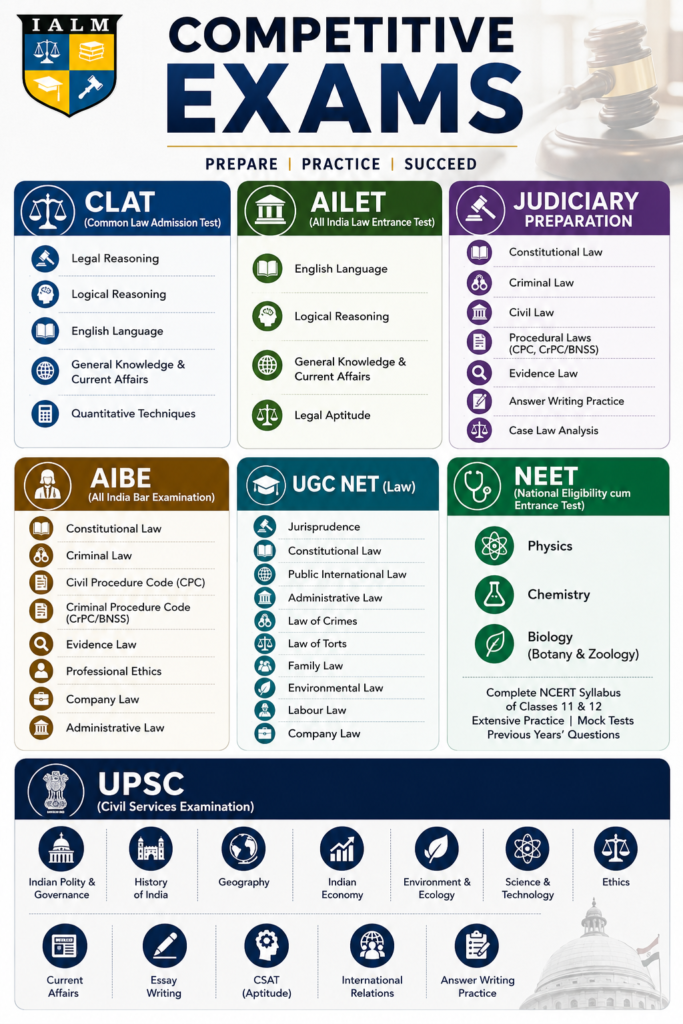
COMPETITIVE EXAMS: CLAT (Common Law Admission Test) – Legal Reasoning, Logical Reasoning, English Language, General Knowledge & Current Affairs, and Quantitative Techniques.
AILET (All India Law Entrance Test) – English Language, Logical Reasoning, General Knowledge & Current Affairs, and Legal Aptitude.
Judiciary Preparation – Constitutional Law, Criminal Law, Civil Law, Procedural Laws (CPC, CrPC/BNSS), Evidence Law, Answer Writing Practice, and Case Law Analysis.
AIBE (All India Bar Examination) – Constitutional Law, Criminal Law, Civil Procedure Code (CPC), Criminal Procedure Code (CrPC/BNSS), Evidence Law, Professional Ethics, Company Law, and Administrative Law.
UGC NET (Law) – Jurisprudence, Constitutional Law, Public International Law, Administrative Law, Law of Crimes, Law of Torts, Family Law, Environmental Law, Labour Law, and Company Law.
NEET (National Eligibility cum Entrance Test)– Physics, Chemistry, and Biology (Botany & Zoology), covering the complete NCERT syllabus of Classes 11 and 12 along with extensive practice, mock tests, and previous years’ questions.
UPSC (Civil Services Examination)– Indian Polity & Governance, History of India, Geography, Indian Economy, Environment & Ecology, Science & Technology, Ethics, Current Affairs, Essay Writing, CSAT (Aptitude), International Relations, and Answer Writing Practice.
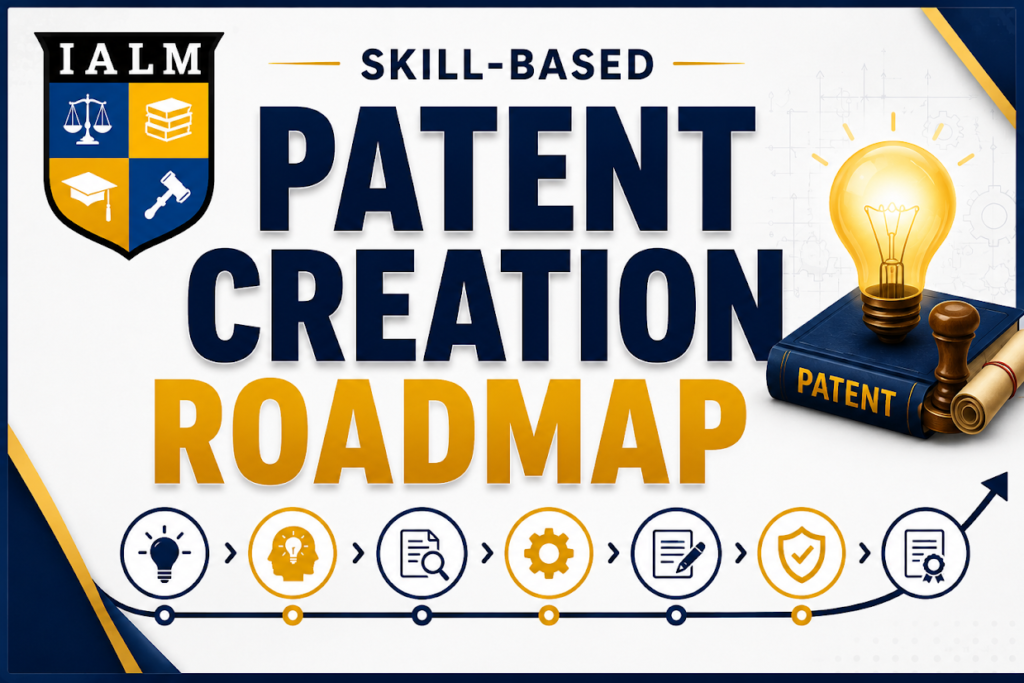
Skill-Based – PATENT CREATION ROADMAP: Introduction to Intellectual Property Rights (IPR), Understanding Patents, Types of Patents, Patentability Criteria, Prior Art Search, Drafting a Patent (Specification Writing), Filing a Patent Application, Publication of Patent, Examination Process, Responding to Objections (FER), Grant of Patent, Patent Infringement, Licensing and Commercialisation, Patent Portfolio Management
Skill-Based – SALES TRAINING: Introduction to Sales – The Big Picture, Mindset & Habits for Success, Understanding Customer/Buyer Psychology, Sales Structure and Methodologies (Step-by-Step Process), Mastering Communication for Sales, Making the First Impression (Rapport Building), Handling Objections Like a Pro, Negotiation and Closing Techniques, Questioning Techniques in Sales, Achieving Sales Targets and Performance Tips, Follow-Up & Retention Skills
MANAGEMENT SUBJECTS (BBA LEVEL): Principles of Management, Organisational Behaviour, Human Resource Management, Business Economics, Financial Management, Marketing Management, Operations Management, Strategic Management, Business Law, Business Ethics and Corporate Governance, Entrepreneurship Development, Management Information Systems (MIS), Business Communication, Quantitative Techniques, Research Methodology, International Business
HIGHER EDUCATION – BOTANY (B.SC & M.SC): Plant Diversity, Microbiology, Phycology, Mycology, Bryology, Pteridophytes, Gymnosperms, Angiosperms, Plant Anatomy, Plant Morphology, Cell Biology, Genetics, Molecular Biology, Plant Physiology, Biochemistry, Ecology, Environmental Botany, Plant Biotechnology, Economic Botany, Plant Taxonomy, Evolution, Plant Pathology, Cytology, Tissue Culture, Bioinformatics, Research Methodology
WHY CHOOSE IALM ONLINE TUITIONS?
- Expert Tutors
Learn from experienced educators who simplify complex concepts and focus on practical understanding. - Personalized Learning Approach
Every student is different — we tailor our teaching methods to match individual learning styles and pace. - Interactive Live Sessions
Engaging classes with real-time doubt solving, discussions, and continuous interaction. - Structured Study Material
Well-designed notes, assignments, and tests to ensure complete conceptual clarity. - Performance Tracking
Regular assessments and feedback to monitor progress and improve consistently.